
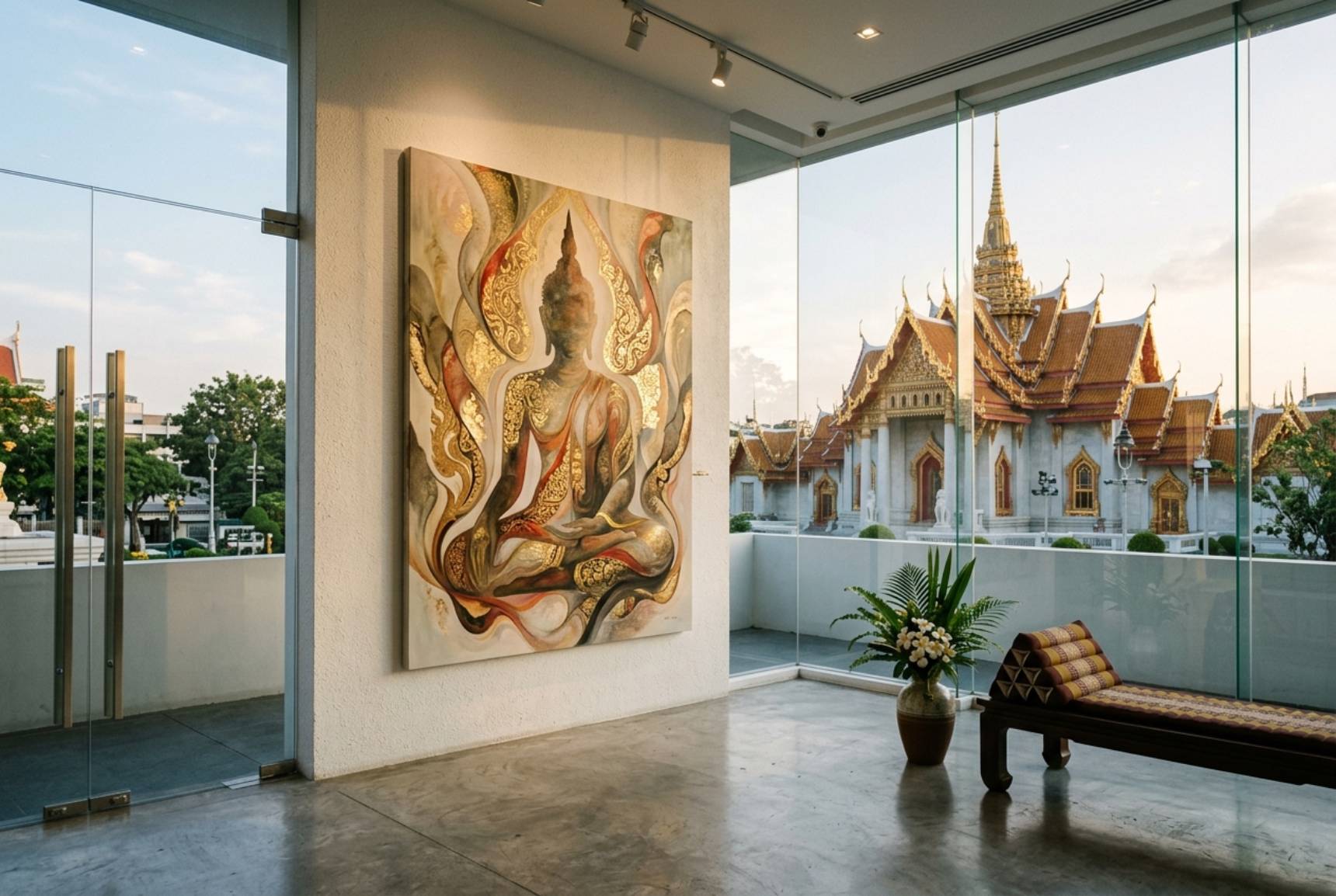
Thai art has always been closely connected to spirituality. From the serene Buddha images and intricate murals of historic temples to contemporary paintings, sculptures, and installations, spiritual ideas continue to influence the way Thai artists understand beauty, identity, nature, and human experience.
Today, this connection is evolving. Contemporary Thai artists are not simply reproducing traditional religious imagery. Instead, many reinterpret spiritual concepts through modern techniques, abstract forms, unexpected materials, and personal perspectives. The result is a fascinating dialogue between Thailand's ancient heritage and its contemporary creative culture.
The Spiritual Foundations of Thai Art
To understand modern Thai art, it is useful to look first at the country's temple traditions. Buddhist temples, or wats, are important expressions of Thai spirituality, architecture, craftsmanship, and cultural identity. Their murals, sculptures, decorative patterns, and architectural details combine artistic beauty with religious meaning.
Traditional Thai art developed distinctive visual languages that communicate stories and spiritual ideas. Buddha images, for example, are represented in different postures and attitudes, each associated with particular narratives, teachings, or qualities. The serene expressions and graceful forms of Sukhothai Buddha images are particularly associated with an ideal of spiritual calm and transcendence.
Traditional Thai painting also incorporates lai Thai, a sophisticated system of decorative patterns characterized by flowing lines, botanical forms, flames, and intricate ornamental details. These patterns have become an important part of Thailand's visual identity while continuing to inspire artists working in contemporary mediums.
From Temple Murals to Contemporary Canvases
One of the most visible connections between traditional and modern Thai art is the continued use of narrative imagery. Historic temple murals often depict Buddhist stories, scenes from the Jataka tales, cosmological ideas, and aspects of everyday life. Rather than existing solely as decoration, these paintings communicate stories and values to viewers.
Contemporary artists can approach storytelling in very different ways. A modern canvas may replace detailed narrative scenes with abstract forms, symbolic figures, fragmented compositions, or contrasting colors. Yet the underlying interest in human existence, morality, impermanence, nature, and spiritual transformation can remain.
This relationship between old and new is not simply a matter of copying traditional imagery. Modern Thai painting has developed through encounters between local traditions and international art movements, allowing artists to reinterpret familiar cultural themes through modernist, surrealist, abstract, and experimental approaches.
The Buddha as an Artistic Symbol
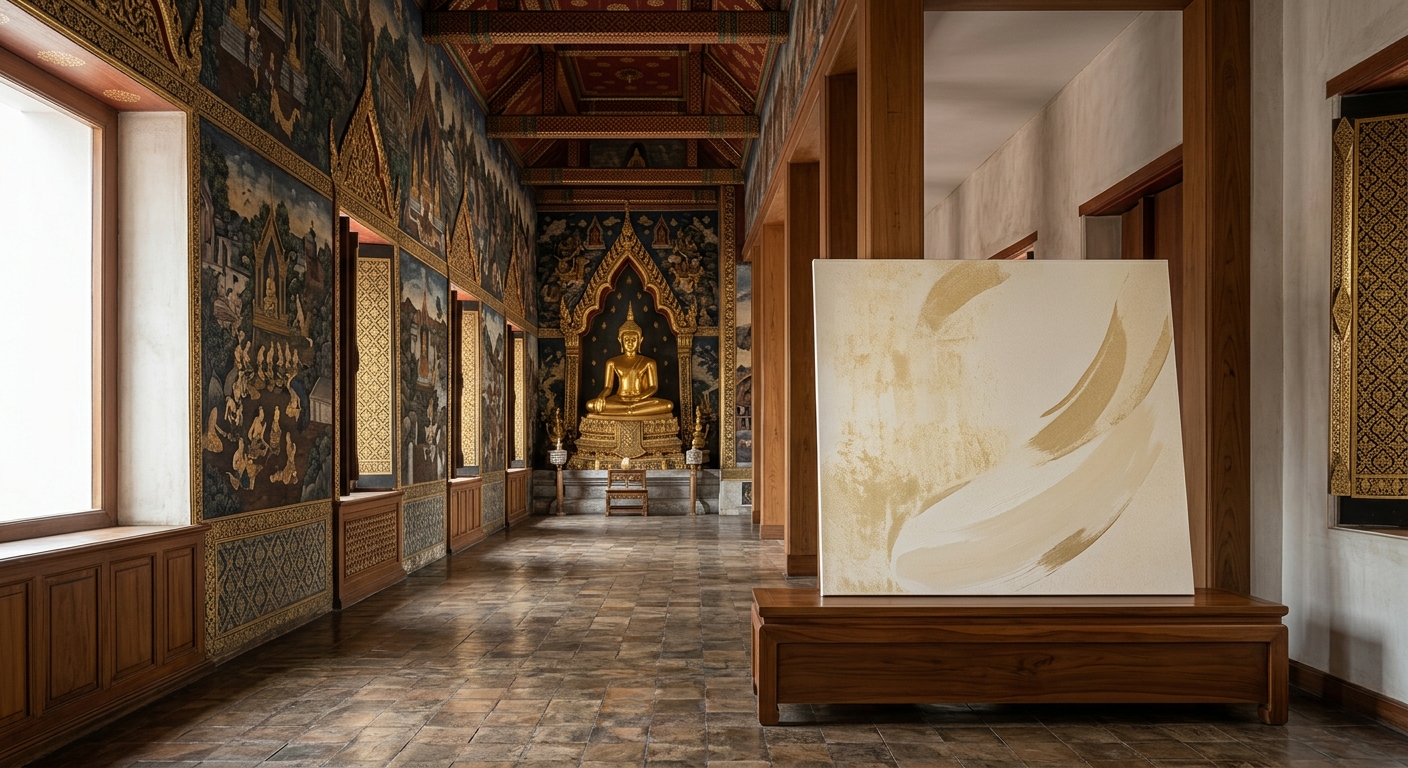
The Buddha remains one of the most recognizable subjects in Thai art, but contemporary interpretations can extend far beyond conventional representations of a seated Buddha.
For many artists, Buddhist imagery can provide a visual language for exploring concepts such as peace, suffering, desire, impermanence, meditation, and the relationship between the physical and spiritual worlds. A Buddha figure may appear alongside contemporary objects, distorted forms, unusual colors, or abstract surroundings.
This transformation demonstrates how cultural symbols can continue to evolve. The meaning of an image can change according to its context, the artist's intention, and the viewer's experience.
Thai Buddhist art has historically demonstrated considerable variety and adaptability. Different Buddha postures and visual traditions developed across periods and communities, showing that religious imagery was never completely static. This creative flexibility can also be seen in contemporary Thai art.
Nature, Impermanence, and the Human Experience
Thai spirituality is not limited to temple architecture or religious figures. Concepts connected to nature, impermanence, balance, and the human experience can also appear in contemporary artistic expression.
Artists may use organic shapes, landscapes, animals, flowers, water, light, or changing textures to suggest the temporary nature of existence. These elements can create artworks that encourage viewers to slow down and contemplate rather than simply observe.
In this sense, modern art can share something with meditation: both can invite attention to the present moment. A quiet composition, repeated pattern, subtle movement, or carefully balanced arrangement can encourage a viewer to spend time looking and reflecting.
The Influence of Thai Decorative Patterns
Traditional Thai ornamentation continues to provide a rich source of inspiration for contemporary artists and designers. Lai Thai patterns are recognizable for their intricate curves, rhythmic forms, and highly detailed compositions.
Modern artists may simplify these motifs, enlarge them, fragment them, or combine them with contemporary geometric forms. The traditional visual vocabulary can therefore become part of an entirely new artistic language.
This approach demonstrates how heritage can remain relevant without being frozen in the past. Traditional motifs can be transformed while still retaining connections to Thai history and aesthetics.
Thawan Duchanee and a New Interpretation of Spirituality
One important example of the relationship between spirituality and modern Thai art is the work of Thawan Duchanee. The internationally recognized artist developed a distinctive visual language influenced by Buddhist ideas as well as Eastern and Western philosophy.
Rather than simply depicting temples or conventional Buddha figures, Duchanee explored the tension between the material and spiritual worlds. His powerful imagery, dramatic compositions, animals, human forms, and symbolic elements created a contemporary interpretation of Buddhist thought.
His approach illustrates an important development in Thai art: spirituality can be explored through personal interpretation rather than literal religious representation. Contemporary artists can engage with traditional ideas while questioning, transforming, and expanding their visual meanings.
Beyond Religion: Spirituality in Contemporary Thai Art
Modern Thai art is not exclusively religious. Contemporary artists address a wide range of subjects, including identity, politics, society, the environment, memory, gender, technology, and globalization.
However, spiritual ideas can still influence how artists approach these subjects. Concepts such as interconnectedness, change, balance, compassion, and impermanence can provide conceptual frameworks for exploring contemporary life.
This creates an important distinction between religious imagery and spiritual influence. An artwork does not need to contain a Buddha image or temple to reflect ideas that have developed within Thailand's spiritual and cultural environment.
When Ancient Spaces Inspire Modern Creativity
Thai temples themselves can be understood as immersive works of art. Architecture, sculpture, painting, light, sound, ritual, and movement come together to create environments designed to encourage contemplation and connection.
Contemporary installations and experiential art can create a similar relationship between artwork and viewer. Instead of looking at a painting from a distance, visitors may walk through an installation, interact with materials, experience changing light, or become surrounded by sound and imagery.
This connection between environment and experience is particularly relevant to Bangkok's modern art scene, where galleries, cultural spaces, creative districts, and exhibitions bring together traditional references and contemporary artistic practices.
Bangkok: Where Tradition Meets Contemporary Art
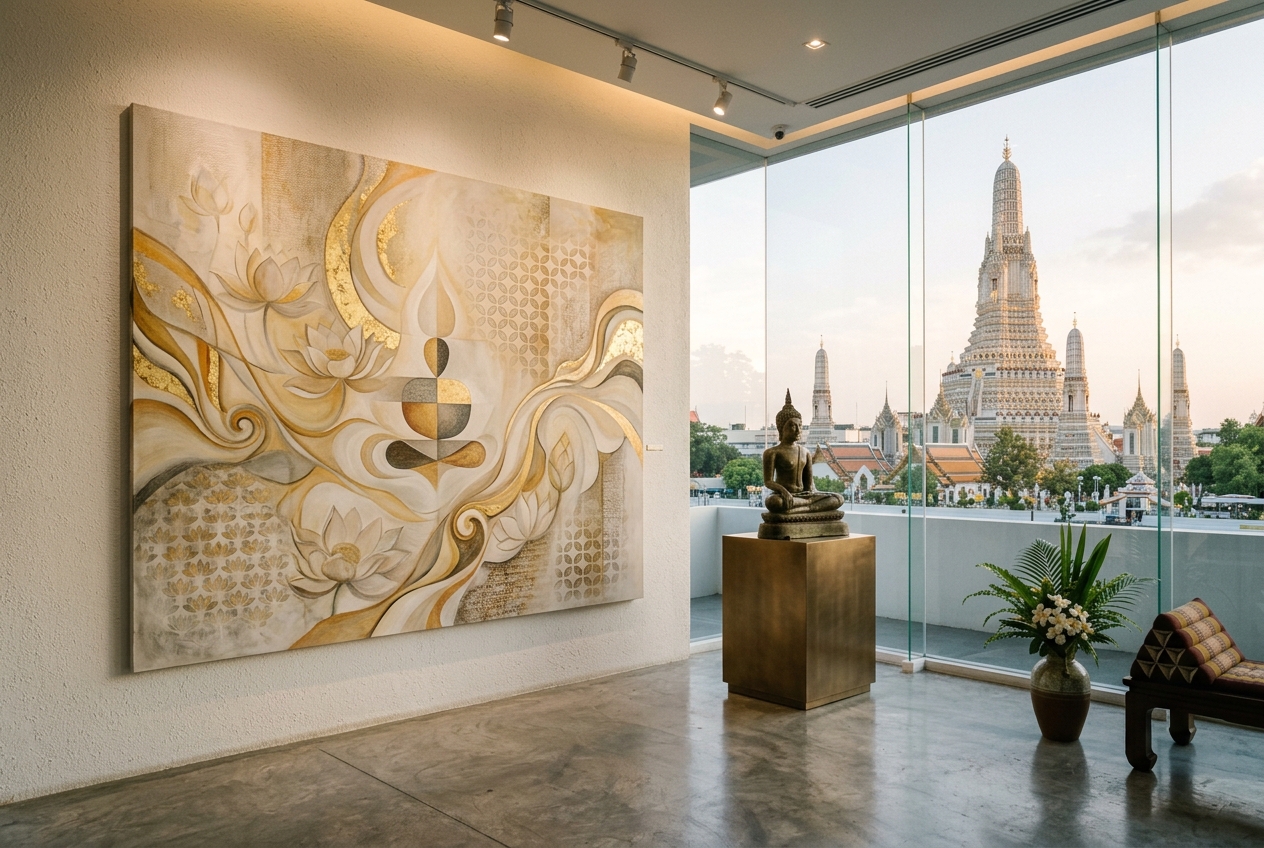
Bangkok provides a unique setting for this cultural dialogue. Historic temples and traditional neighborhoods exist alongside galleries, museums, creative spaces, design studios, and contemporary exhibitions.
The city's artistic landscape reflects Thailand's broader relationship with heritage. Traditional aesthetics do not disappear as modern culture develops. Instead, they can be reinterpreted through new materials, technologies, and artistic perspectives.
For visitors exploring Bangkok, this makes the city particularly interesting from an artistic perspective. A day spent experiencing historic architecture and temple art can provide a completely different understanding of contemporary exhibitions encountered later in the city.
Art as a Space for Reflection
Perhaps the strongest connection between Thai spirituality and contemporary art is the idea of creating space for reflection.
Traditional Buddhist art often encourages contemplation through serene imagery, symbolic narratives, and carefully designed environments. Contemporary art can achieve something similar through abstraction, minimalism, atmosphere, texture, and immersive experiences.
For viewers, the experience does not necessarily require a specific religious interpretation. A work of art can simply create a moment of stillness in a busy city, encouraging visitors to pause, observe, and consider their own thoughts and emotions.
The Continuing Evolution of Thai Art
The journey from temples to contemporary canvases is not a simple transition from old art to new art. It is an ongoing conversation between generations, ideas, techniques, and cultural perspectives.
Thailand's artistic heritage continues to provide contemporary creators with an extensive vocabulary of forms, stories, symbols, and philosophies. At the same time, modern artists reinterpret this heritage in ways that respond to today's rapidly changing world.
That balance between tradition and experimentation is one of the most fascinating characteristics of Thai art. Ancient spiritual concepts can appear in a contemporary painting, a sculpture, a digital artwork, or an immersive installation without losing their connection to the cultural landscape from which they emerged.
Discovering the Spiritual Side of Thai Art
From the peaceful expression of a Sukhothai Buddha to the intricate patterns of temple murals and the bold experimentation of contemporary artists, Thai art reveals a culture where creativity and spirituality have long existed together.
For art lovers, discovering this relationship offers more than an appreciation of beautiful objects. It provides an opportunity to understand how Thai artists have transformed ideas about spirituality, nature, identity, and human existence into visual experiences.
At Art-Bangkok, art can be experienced as part of a wider journey of culture, creativity, and relaxation. By bringing artistic inspiration into an environment designed for calm and indulgence, visitors can experience another side of Bangkok's creative spirit—one where looking, reflecting, and enjoying the moment become part of the experience.
From sacred temple walls to contemporary canvases, Thai art continues to evolve while maintaining a connection to the ideas and traditions that have shaped it for centuries.